Archive
What Nobody in Williamsburg Knew
A few days ago a reader on the interactive fiction forum asked a polite question about one sentence. I had described Historical Williamsburg Living Narrative as a game in which you arrive in Williamsburg on the evening of April 19, 1775, “just as word of the battles at Lexington and Concord begins reaching the colonial capital.” He happened to be reading a book about Lexington and Concord. Was the news really in Virginia that same evening?
It was not, and he had the reference to prove it. The fighting began that morning in Massachusetts and went on through the afternoon. The news traveled south by express rider, town to town, and it reached Williamsburg late on April 28 or early on the 29th. On the evening my game opens, nobody in the city could have known.
He apologized for being pedantic. He was not being pedantic. He was doing exactly what I hope players of a history game will do.
Why the Right Answer Is the Better Story
Once I looked at it squarely, the correction improved the game. You, the player, know what happened in Massachusetts that morning. No one you meet does. The tavern keeper does not know. The printer’s apprentice does not know. The Governor does not know either, and that matters, because on the night of April 20 Lord Dunmore sends Royal Marines to carry off the colony’s gunpowder with no idea that the war has already started hundreds of miles to the north. The two pieces of news do not collide until a week later.
So version 1.71 fixes the one character who spoke as if the news had arrived. Richard Charlton, who keeps the coffeehouse and prides himself on being the best informed man in town, now tells you there is nothing fresh from Massachusetts and that everyone is waiting on it. I am correcting my descriptions of the game as well.
Patrick Henry Comes to Town
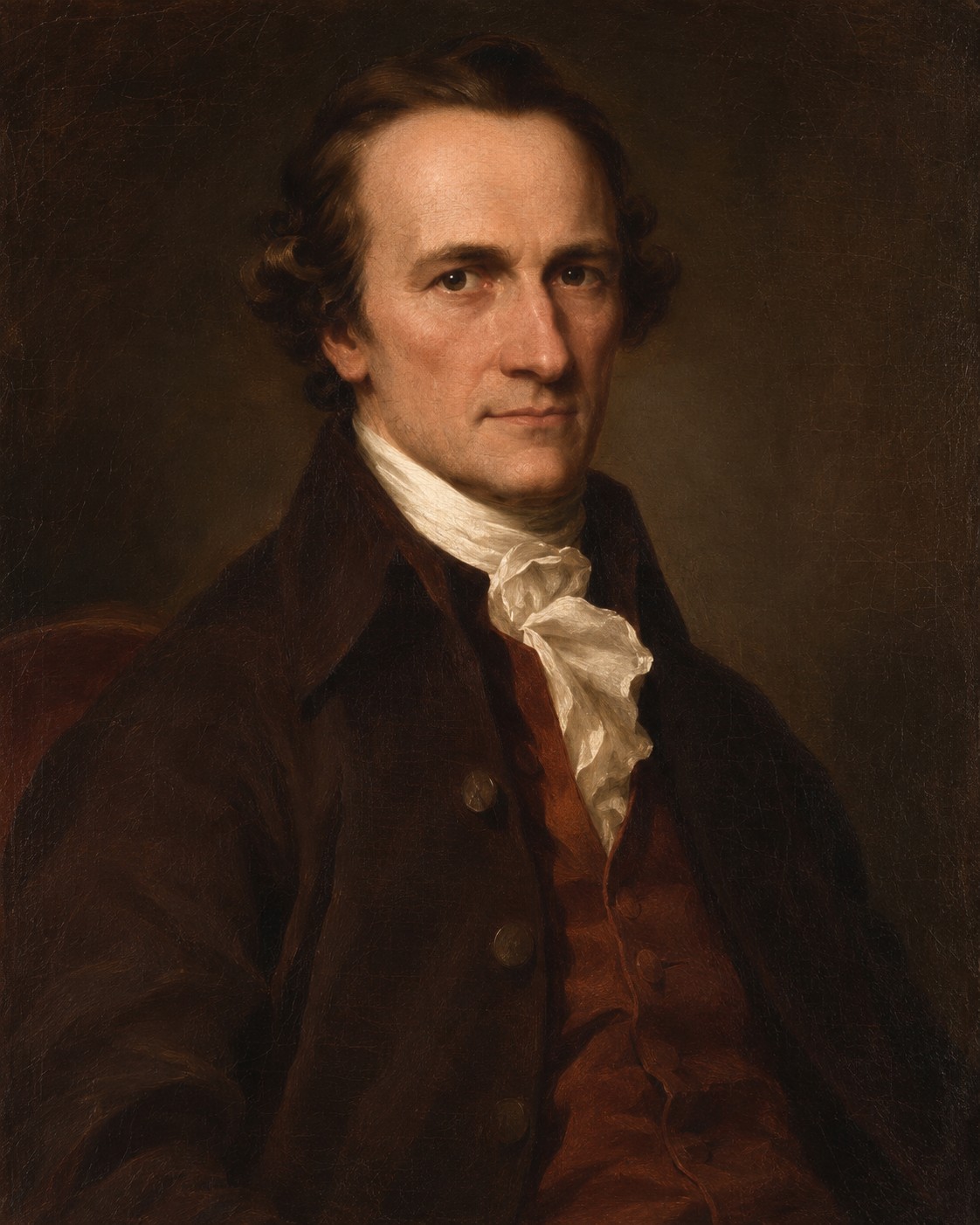
The same care went into the largest addition in this update. Patrick Henry is now in Williamsburg for one night. You can find him at the Raleigh Tavern on the opening evening and again at breakfast the next morning, before he rides home to Hanover.
The record says Henry was at home in Hanover when he learned the powder had been taken, and that he marched toward Williamsburg with the county militia at the start of May. Nothing I have found places him in the city on April 19, and nothing rules it out. So the game takes one small liberty and is honest about it: he visits, he speaks his mind about a Governor he does not trust, and he is gone a full day before the trouble starts. His friends have warned him that his name is being spoken at the Palace more than is healthy, which is why he keeps out of the public room after dark and leaves by daylight.
If you are at the Raleigh at the right moment that evening, the room will call for the Richmond speech and he will give them the close of it. One caution for the historically minded: nobody wrote that speech down when it was delivered. The words we all know come from William Wirt’s biography of 1817, pieced together from the memories of men who were there. That is the text the game uses.
A Fuller Town
Seven more people now live in the taverns and the coffeehouse: Patience Anderson, Samuel Briggs, Dr. Ephraim Coles, Richard Charlton, Josiah Holt, Mrs. Vobe, and Ned Pulliam. They were written long ago and, through an oversight of mine, never actually appeared. The cast now stands at 22.
Late on the night of April 20, a file of Marines now moves through town toward the waterfront, a few hours before the powder is taken. That event was never occurring, which meant part of the score could not be earned. And you can now get a proper night’s sleep on every night of your visit, which was harder than it should have been.
Corrections Welcome
This project grew out of research on interactive fiction as a way to teach, and a correction from a careful reader is that idea working as intended. If something in the timeline looks wrong to you, I would much rather hear about it than not.
One practical note: saved games from versions before 1.70 will not load in the new version.
Historical Williamsburg Living Narrative is available for Windows on itch.io for $4.99, with a free demo: interactivefact.itch.io/hwln
Work Resumed and the End Is in Sight!
An Interactive Narrative for the 250th Anniversary of American Independence
Posted by Hap Aziz, Ed.D. · Development Update
On July 4, 2026, the United States will mark 250 years since the signing of the Declaration of Independence. It is a milestone that invites Americans to look back at the extraordinary spring of 1775 — the months when revolution moved from rhetoric to reality. We are building something for that moment: a text-based interactive narrative called Historical Williamsburg Living Narrative, and after a period away from the project, development has resumed in earnest.
The game is not a quiz. It is not a drill. It is an invitation to step into colonial Williamsburg at one of the most charged moments in American history and see what you can learn by being there.
You are Nathaniel Blake — a wealthy Richmond merchant visiting the Virginia capital on the evening of April 19, 1775. You have appointments with George Wythe and Peyton Randolph. Your ship, the brigantine Perseverance, is in port at Yorktown. And you have just found a sealed letter on the forecourt of the Governor’s Palace.
The Night That Changed Virginia
The date matters enormously. Patrick Henry delivered his famous speech at St. John’s Church in Richmond on March 23, 1775 — just weeks before Blake arrives. The colonies are tense. Militias are drilling. And in Williamsburg, something is about to happen.
On the night of April 20-21, 1775, Lord Dunmore — Virginia’s royal governor — secretly ordered twenty Royal Marines from the armed schooner HMS Magdalen to remove the colony’s gunpowder from the Public Magazine. They worked by lantern light, loading fifteen half-barrels onto a wagon and transporting them to the James River before dawn. When Williamsburg woke up, the powder was gone.
The Gunpowder Incident, as historians call it, was one of the catalytic events of the American Revolution in the South. It provoked Patrick Henry to march on Williamsburg with armed militia. It destroyed whatever remained of Dunmore’s relationship with the colonial government. Within two months, the Governor had fled the Palace and taken refuge on a British warship. Virginia would never again have a royal governor.
In Historical Williamsburg Living Narrative, the player arrives the evening before — and has the opportunity to witness all of it.
What the Game Looks Like
314 Locations to Explore
The game world covers the historic area of colonial Williamsburg in substantial detail: the Governor’s Palace and its grounds, the Wythe House, the Randolph House, Anderson’s Tavern, the Public Magazine, the Capitol building, Bruton Parish Church, Chowning’s Tavern, the Raleigh Tavern, the printing office, the courthouse, and dozens of streets, gardens, and outbuildings connecting them.
Every location has a physical description, time-appropriate ambient detail that changes through the evening and into the early morning hours, and exits to the surrounding world. Move times reflect real distances — a walk from the Palace Circle to the Wythe House takes longer than a step from the Foyer to the Parlor.
Characters Who Know Their World
The game features ten non-player characters, each placed within the historical and social fabric of April 1775 Williamsburg. Players can approach and speak with them, and each character has their own knowledge, opinions, and concerns about the political situation:
- John Anderson — proprietor of Anderson’s Tavern, where Blake is staying
- George Wythe — Virginia’s great legal scholar; one of Blake’s appointments, and a win-condition character
- Peyton Randolph — Speaker of the House of Burgesses; the other win-condition character
- Lord Dunmore — the Royal Governor himself, whom Blake meets in the Palace Parlor
- Mr. Hedges — the Palace butler, a study in composed authority
- Tobias Greer — a printer’s apprentice who has opinions about everything
- Reverend Whitfield — the rector of Bruton Parish, navigating divided loyalties
- Margaret Skelton — a loyalist merchant whose situation grows more precarious by the week
- Cato Freeman — a free Black cooper whose perspective on liberty is unlike anyone else’s in town
- Nance — an enslaved woman in the Randolph household, whose situation the game does not shy away from
Each character has topics they’ll discuss, information only they possess, and — crucially — dialogue that changes after the powder theft. The Williamsburg of April 21 feels different from the Williamsburg of April 20, because it is.
The Governor’s Palace Sequence
The sealed letter Blake finds at the start of the game creates one of the narrative’s most carefully designed sequences. Returning it to the Palace requires Blake to knock at the locked front door, wait while the butler consults the Governor, be received in the Parlor, and sit through a brief but charged audience with Lord Dunmore — who is, on this particular evening, a man with a great deal on his mind.
Dunmore is not a villain in the game’s telling. He is charming, intelligent, and genuinely grateful. He deflects certain questions very smoothly. Players who pay attention to what he doesn’t say will find that the conversation takes on a different character once the powder is gone.
‘The colony’s prosperity and the Crown’s interest are not in conflict, Mr. Blake,’ he says at length. ‘Whatever the political gentlemen may argue. Trade requires order. Order requires authority. These are not complicated ideas, though some seem determined to complicate them.’
A Full Day Before the Theft
One of the most important design decisions made during this development phase was shifting Blake’s arrival to April 19 — giving the player an entire day before the powder removal happens. April 20 becomes an investigation: visit Wythe and Randolph, walk through town, talk to characters about the political climate. Players who know their history may recognize the signs. Players who don’t will learn.
The theft itself happens around 3:50 in the morning of April 21. If Blake is awake and near the Magazine, he witnesses it directly. If he’s asleep at the tavern, he wakes to an uneasy feeling he can’t name — and finds out what happened at dawn.
The game then offers a full day on April 21 to respond: to find Wythe or Randolph and tell them what you know, to speak with characters who are now frightened or angry, to absorb the moment before departure on the morning of April 22.
An Educational Tool First
Historical Williamsburg Living Narrative is designed as an educational tool — suitable for classroom use, self-directed learning, and anyone curious about what life in colonial Virginia actually felt like on the eve of revolution.
The game does not oversimplify. Dunmore had genuine reasons for his actions; the colonists had genuine grievances; the enslaved people of Williamsburg had a perspective on ‘liberty’ that did not map neatly onto Patrick Henry’s. The game tries to hold all of that without turning it into a lecture.
Players who complete the experience will leave with a concrete understanding of: the Gunpowder Incident and why it mattered; the social geography of colonial Williamsburg; the range of political opinion in Virginia in April 1775; and the human texture of a moment that is often reduced to famous speeches and battles.
A Note on the Technology
The game runs as a standalone Windows application with a period-appropriate parchment interface. It requires no internet connection and no installation beyond copying the executable. Save and load functionality allows students to resume progress between sessions, and saved games are stored securely in the user’s application data folder.
The game features a natural-language parser that recognizes multi-word commands and noun phrases — ‘examine the sealed letter,’ ‘talk to George Wythe,’ ‘open the east door’ — rather than requiring rigid syntax. It is intended to feel like reading and playing simultaneously, not like filling in a form.
Looking Ahead
Development is targeting a launch window aligned with the 250th anniversary of American independence in the summer of 2026. Remaining work includes: completing NPC dialogue for all characters, building the full victory condition and scoring system, adding the historically accurate presence of the HMS Magdalen sailors at the Palace, and polishing the dozens of locations that still carry placeholder descriptions.
The bones of the experience are in place. The world exists, the characters speak, the powder disappears in the night, and history turns its corner. What remains is filling in the texture that makes a player feel they were really there.
If you have ever stood in front of the Governor’s Palace in Williamsburg and wondered what it was like on the night before everything changed — this is an attempt to show you.
Historical Williamsburg Living Narrative is a work in progress. Updates will be posted here as development continues. The target platform is Windows; the target audience is anyone who has ever wished history class felt more like being there.
Hap Aziz, Ed.D.
March 2026

