Graphic Enhancement to Traditional IF
The Interactive Fiction I grew up on (starting with the Scott Adams text adventures that I got in cassette form for my TI 99/4A computer) was all text based. No graphics at all; just two-word phrases that eventually turned into more sophisticated Infocom game sentences, but still words only. In fact, one of my favorite computer game ads was the Infocom print ad that said something to the effect of “We stick our graphics where the sun don’t shine,” and then there was a picture of the human brain. Pretty clever, and you can see it here.
One of the characteristics that makes Inform 7 so appealing as an IF development environment is that it allows a person to rapidly put together an IF game in the form of those old Infocom games: a pretty robost parser that allowed for sentence input. However, Inform 7 has made a number of improvements to the output it produces, compared to the earlier Infocom games. One of those improvements is the ability to integrate graphic images into the Inform code for display when someone plays the game.
I’ve decided to take advantage of this feature during development of the Historical Williamsburg Living Narrative. I’ll be using the photographs I have taken of Williamsburg, and I’ll have the photographs changed into a more comic-like illustration. Below is a sample of the Capitol Building already having gone through the image processing.
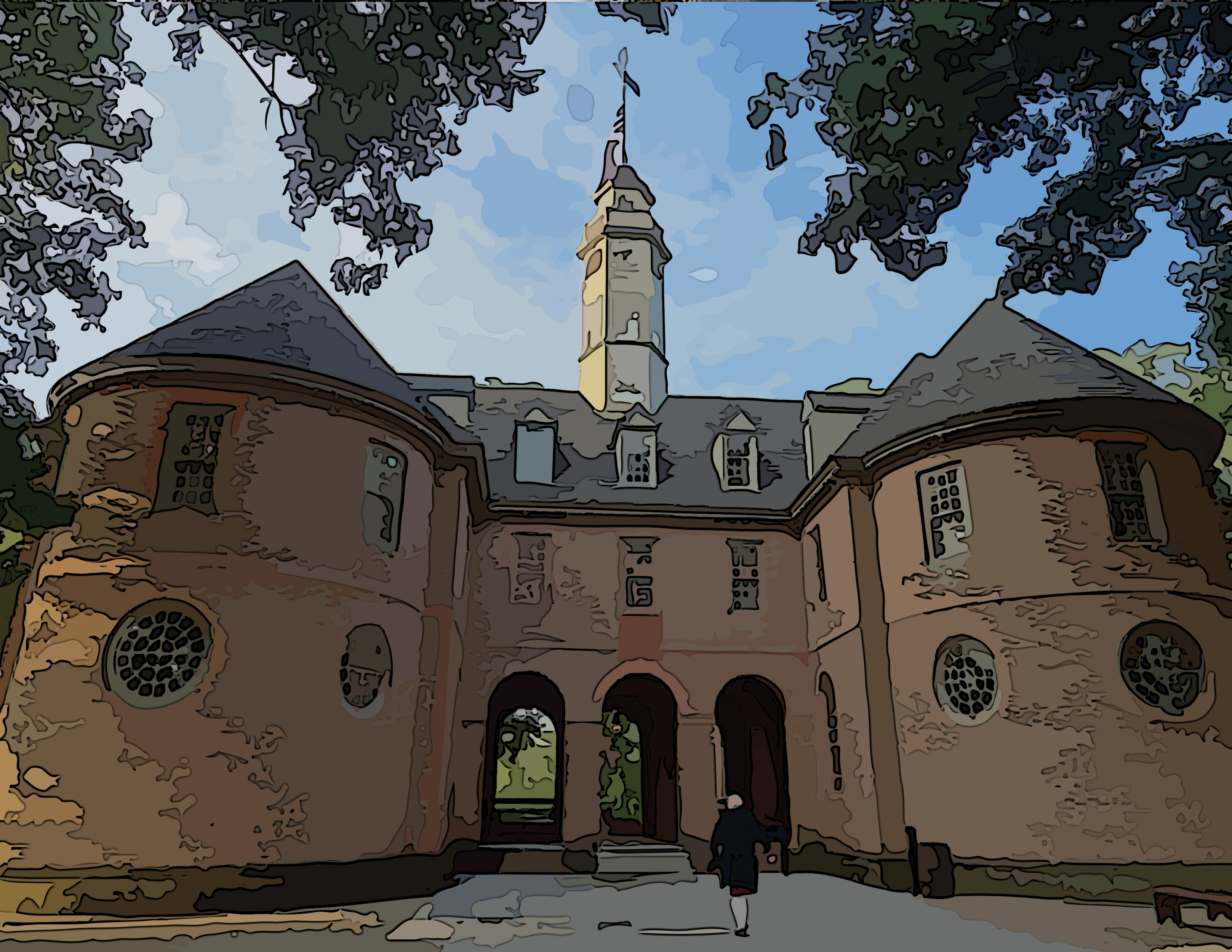
As you can see, the photograph has been altered to appear as more of an illustration. I’ll do this for all of the photographs to be used in the game. Please share your thoughts: do you like this approach to Interactive Fiction? Or does IF need to be more “old school”?
Streamlined Williamsburg Map
In my last blog post (Fun with Maps) I discussed the complexities around map development for Interactive Fiction, especially given the design tension between maintaining historical accuracy and fostering engaging gameplay. During my most recent trip to Williamsburg last September, I found that the Colonial Williamsburg Foundation helped address the map dilemma by issuing a simplified version of their visitor map. This is the visitor map that is currently being published (along with the daily events in the colonial city area).

I took this map and eliminated the extraneous information based on the actual game and story requirements. That gave me a very clean map from which to work. You can see that this map provides a layout of the relative positions of buildings, the streets they are on, and distance information.

Using this clean map, I marked the positions of the buildings and other navigation junctures that would be needed in (this version of) the game. Then I connect the locations where I wanted pathways, so that I could visualize the compass headings to use in terms of game commands. (You can see the blue lines connecting the red and green squares.)

Finally, I pulled the background out in order to have the unadorned map to use in building navigation functionality within Inform 7.
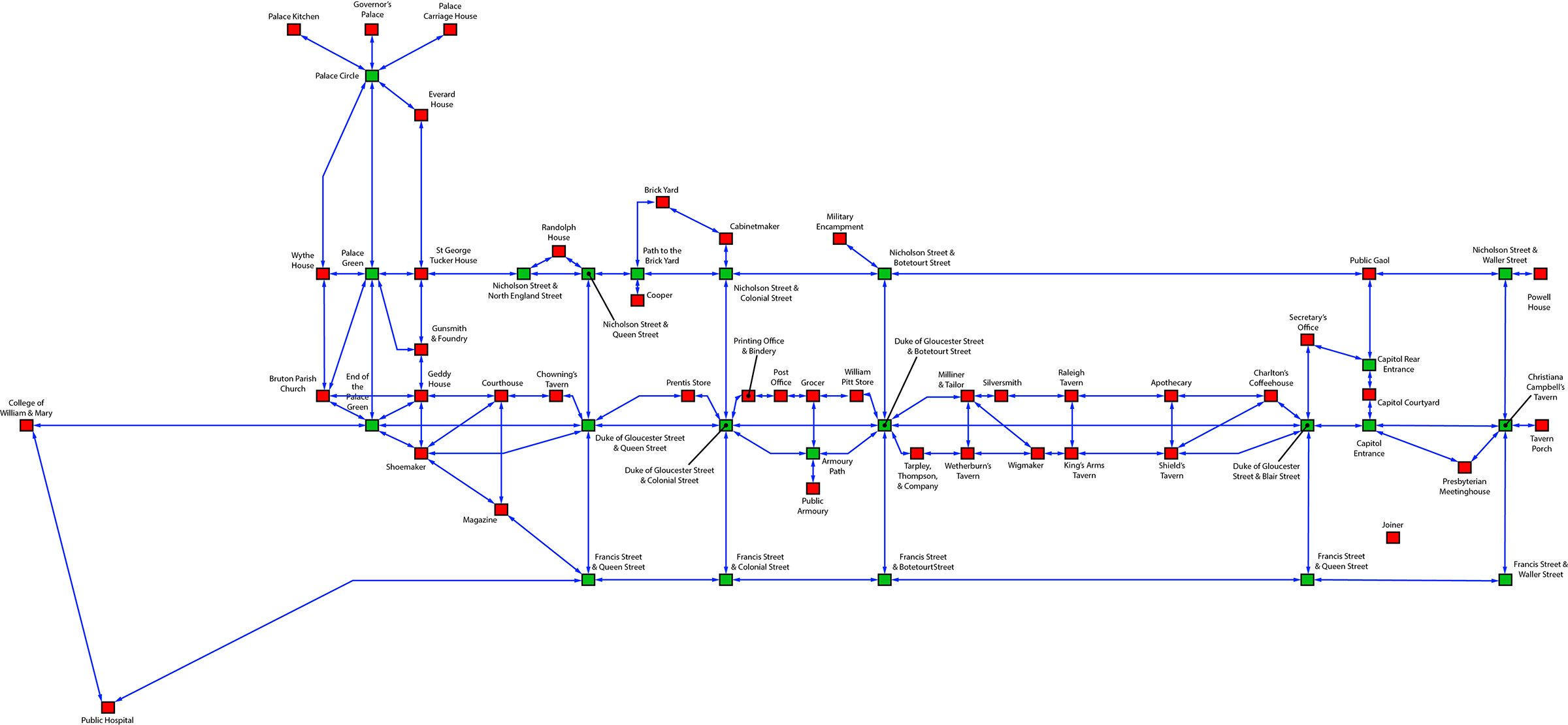
The red boxes represent buildings or structures that have further navigation within, while the green boxes are simply outside locations. Using this map, I was quickly able to create basic navigation in Inform 7, and I am using the map as a location checklist for the location descriptions. (Additionally, I am creating the logic in Inform 7 to handle multiple stops at the same location, and requests for more information regarding locations.
In addition, this map allowed me to visualize some navigational shortcuts to help with the flow of the game. For example, I’ve created a custom command “street” that functions at many of the building locations on the Duke of Gloucester Street (that’s the main street running from the College of William & Mary in the west to the Capitol Building in the east). When a player is at the entrance of one of those buildings, using the “street” command will take the player to one of a number of unmarked positions on the Duke of Gloucester Street, between the two cross streets that apply to the building where the player is. From the unmarked position, the player can see the buildings up and down between the cross streets and choose to navigate directly to any of them. These unmarked positions on the Duke of Gloucester Street are not accessible through standard compass-direction navigation.
Within the next week or two, I’ll have a robust version of the game navigation completed in Inform 7 and available for download to the original Kickstarter backers.
Fun with Maps

Maps are essential to many Interactive Fiction games, especially those that involve activity in various locations. Interactive Fiction game maps that deal with real locations, however, are challenging to implement, as there is a trade-off to be had between realism and playability. If the design is meant to represent the physical layout with utmost fidelity, the details of the map can potentially slow down and frustrate game play as the player is forced to move from one seemingly meaningless location to another in order to get to the desired destination. It’s similar to the counterpoint between a flight simulator and a flight game–the realism of a true simulator can be very boring, unless it’s the simulation itself that interests you.
Likewise, the conflicting visions of the HWLN: is it a simulation of the physical layout of Williamsburg as it was in the months leading up the signing of the Declaration of Independence, or is it a game about the events taking place during that time? That conflict plays itself out everytime I return to the map and struggle with the appropriate level of detail to include. I’ve been wanting the game to be both, but that may not be the wisest choice for the HWLN as a game.
Part of the challenge was addressed in part by the new daily maps published by the Colonial Williamsburg Foundation for visitors. The new map (show in the picture above) is actually a streamlined version of an earlier visitor map which you can view here. The older map is much more detailed, and perhaps in the Colonial Williamsburg Foundation’s thinking, it was not as user friendly. Whatever the case, the new map gives me a good template for a more streamlined game map, on which I am currently working and will implement at least initially in Inform 7.
So for the sake of playability, I’ll work with a less detailed map. But at some point, as an exercise in modeling an accurate picture of history, I’ll return to the “high resolution” version in order to satisfy my inner purist.
HWLN Perks and Progress Update
For those of you that have backed the Historical Williamsburg Living Narrative Project through Kickstarter, the following is information regarding some of the perks. For everyone, here is information also on the progress of the project.
Today and tomorrow, the digital photos and the printed 8×10 photos are going out to the appropriate level backers. Regarding the digital photos, I will be posting a link where you can go and download the photos you would like to have. The are provided in high resolution, suitable for printing if you choose. You will receive the link via email today (12/27/15).
For the printed 8×10 signed photos, I will be sending those tomorrow via first class U.S. mail. Several backers have not yet provided physical mailing addresses, so please check your inbox and junk/spam folder for the survey so you may provide your address. If you prefer, you may contact me directly with your mailing address.
I have resumed work on the game, and currently I am developing interior building descriptions. In the interest of historical accuracy, I am working from photographs I have taken of the building interiors as well as descriptions recorded in research reports available through the Colonial Williamsburg Rockefeller Library: http://research.history.org/.
Parser-based or CYOA? What is IF?
I have an article published over on Storycade. Topic is parer-based versus CYOA; what should be considered “real” Interactive Fiction? Check it out!
Informal Interactive Fiction Survey
If you have a moment, please take a look at this informal survey on IF perceptions I’m conducting. This is mainly about how IF players see parser-based versus CYOA Interactive Fiction. I’ll use the results to give some added color to an article I’m currently writing on the topic.
Navigation QA: Checking the Map
It’s been a while since the last update, as I’ve had several projects eat into my time both for work and for my dissertation. As it turns out, the dissertation is giving me the excu–uh, reason to reapply some focus on the Historical Williamsburg Living Narrative. I’ll need to have a simple version of the game up and running to provide to instructors willing to use the game in the classroom. That means I need to work on it.
I’ve gone back and forth and back again on the development tool to use for the project, from Inform 7 to Adrift to LiveCode, and right now I’m settled on LiveCode for the amount of control I have in building the interface and interaction framework for the game. Currently I’ve developed a simple version of the program that does nothing but navigate through the map, currently 199 separate locations, using abbreviated compass directions: n, ne, e, se, s, sw, w, and nw. The map is below, and you can access a PDF version: Logical Map – Nav Test.

Of course, you will need to actual program to run as well, if you’re interested in checking out the navigation. You may obtain that by accessing it by clicking this link. The file is a Windows version program Zip compressed for faster download. If you’re interested in a Mac version, leave a comment and I’ll compile a version for download.
If you intent to perform quality assurance testing and provide feedback, simply leave comments in response to this post. Be sure to list the error you found, how you encountered the error, and what the error does or doesn’t do. Most likely, errors at this stage will be discrepancies between the visual map and the navigational structure within the program. The visual map (above) is correct; the program will need to be corrected if any discrepancies are found.
One final note: anyone finding errors in the program will be listed as QA testers, being listed in the release version credits. So have at it!

