Archive
You Are in a Maze of Twisty Passages: Getting Lost in Interactive Fiction

The screen shot above is from the Infocom game Hitchhiker’s Guide to the Galaxy (based on the series of books by Douglas Adams). I was a big fan of the Infocom games “back in the day,” and having also read the Hitchhiker’s series, I especially enjoyed this one; at least after I figure out how to put the Babel fish into my ear. Infocom was a company that specialized in what they termed “Interactive Fiction,” that is, text adventure environments written in sophisticated prose format. (Infocom was the company that produced the Zork series of games.) There are a number of reasons that Interactive Fiction is an ideal game format for the Historical Williamsburg Living Narrative project, which I’ll cover in later posts, but now I’ll just briefly cover a little of my own history with the format.
My first encounter with text adventure games (before they were called Interactive Fiction) was back in the fall of 1980 when I got a job with a communications engineering company. The company ran a Data General Eclipse minicomputer, and one of the programs on it was the original Colossal Cave Adventure program written back in the late 1970s. Several of us in the office would stay quite late to sit in the terminal room and explore the virtual world, asking each other for help when the puzzles were particularly challenging. We all spent a fair amount of time typing one- or two-word commands at the cursor hoping we were on track to unravel the puzzles sprinkled throughout the game. Soon after that, I purchased a Texas Instruments TI-99/4A computer, and I was delighted to find a whole series of adventure games by Scott Adams.
It was late in 1981 when I acquired my first IBM PC that I also got my first game for it: Deadline by Infocom. Infocom has developed a natural language parser was also able to “understand” short sentence input rather than simply two-word phrases. It was then that my taste for text adventures, that is, Interactive Fiction grew to the point where I began to write my own. The language available to me on my PC was BASIC, and I wrote thousands of lines of procedural code to build my games. Over the years I’ve used BASIC, Pascal, C, C++, Lingo, Java, and even LISP to build my games, and I’ve continued to experiment with my own parser systems and Interactive Fiction scenarios.
Several years ago, I discovered the Inform software (currently Inform 7) development system. Inform is an environment specifically design to author Interactive Fiction. The language of Inform is set up to support the conventions of Interactive Fiction, which makes it easier to program these types of game. For example, if I wanted to set up a space where there was a Kitchen and a Dining Room, with the Kitchen to the north, I would enter into the Inform 7 engine simply:
> Kitchen is a room.
> Dining Room is a room.
> Dining Room is south of the Kitchen.
At that point, when I run the program I find myself starting out in the Kitchen location. If I then type “s” (for south) at the prompt, I see that I have moved into the Dining Room–and I can type “n” to move back to the Kitchen. Of course, the Inform 7 programming environment supports much more than moving around virtual locations, but the exciting thing is that it takes care of the programming underpinnings while the author/programmer can focus on the logic of the game itself. That is very appealing. One can relatively easily create objects to be manipulated, characters with which to interact, and so on.
The simplicity of the Inform 7 development environment is one of the reasons I’m excited about using it to develop the Historical Williamsburg Living Narrative. I’ll be able to develop and implement my “map” of Williamsburg fairly quickly, and building in the location descriptions and character interactions will be a lot easier than it was when I used more general programming environments. That means I’ll be able to spend much more time in building narrative depth into the game play, and that’s ultimately what makes the Interactive Fiction format so engaging, even though it’s only text on screen. Sometimes graphics gets in the way of imagination; Interactive Fiction is the perfect way to drop the reader into the action of the story and really bring the words to life.
Wanted: Teachers Interested in Interactive Fiction

- Are you a teacher at any grade level with an interest in history?
- Do you have familiarity with the Interactive Fiction format of computer games (or would you like to know more)?
- Would you be willing to participate in a study on the use of Interactive Fiction in curriculum?
- Would you like to learn how you might make use of the Historical Williamsburg Living Narrative project in your class?
If you answered yes to any of these questions, then we need to connect! The Historical Williamsburg Living Narrative is not just about creating a fun Interactive Fiction computer game about some of the exciting events surrounding the birth of the United States. The project is also about providing a tool that can potentially engage more students in a way that promotes thinking and problem-solving skills that can help in all areas of their academic lives.
To connect with the Historical Williamsburg Living Narrative, feel free to post a comment here, or you may email directly at historicalwilliamsburg@gmail.com. We will be happy to answer any questions you might have about the project or about Interactive Fiction in general, and we will work with you so that you and your students can participate interactively with people and events from the early days of this nation.
Like Us On Facebook!
 In keeping with the strategy that social media is one of the ways to grow awareness, we have created a page for the Historical Williamsburg Living Narrative on Facebook. Be sure to go to our page and “Like” us on Facebook now!
Being a Part of the Story. Interactively

The above is a photograph of part of the wall graphics that greet people entering the Colonial Williamsburg* Visitor Center, very near the admissions ticket counter. I especially love this part of the image because of the “be a part of the story” quote. Quite honestly, it is easy to be a part of the story when you visit Colonial Williamsburg. The entire colonial section is like a bubble out of time (with a lot of modern visitors wandering through). When you go, you have the opportunity to see much of life as it was lived through the artisans and craftspeople there. You get to interact with historical figures: on our last visit, my family and I had the opportunity to discuss issues of the day with George Washington in the Governor’s Palace gardens, have tea with Richard Carlton, the merchant-owner of the coffeehouse just across the way from the House of Burgesses, and chat with Lady Susannah Beverly Randolph, mother** of John “The Tory” Randolph, loyalist to the British Crown.
But while my family and I are able to visit Williamsburg fairly regularly, there are many who would but cannot, and many more who are not even aware that such a slice of American history exists. The Historical Williamsburg Living Narrative is an Interactive Fiction project intended for anyone, anywhere in the world to learn about this core piece of the story of the 13 American colonies. Interactive Fiction is a type of computer game that has all the depth and subtleties that only thorough books might offer, but at the same time, it engages the reader in ways that allows them to use the full range of their imaginations and truly be a part of the story. I invite you to be a part of the story of Williamsburg’s history. Please be sure to spread the word to everyone you know that feels excitement at history and at the thought of using their imaginations playing computer games!
*Colonial Williamsburg is a registered trademark of the Colonial Williamsburg Foundation. There is no affiliation between the Colonial Williamsburg Foundation and the Historical Williamsburg Living Narrative project.
** An earlier version of this post incorrectly identified Susannah Randolph as the wife of John “the Tory” Randolph rather than his mother and wife of Sir John Randolph.
Status Update: Kickstarter Launch Checklist
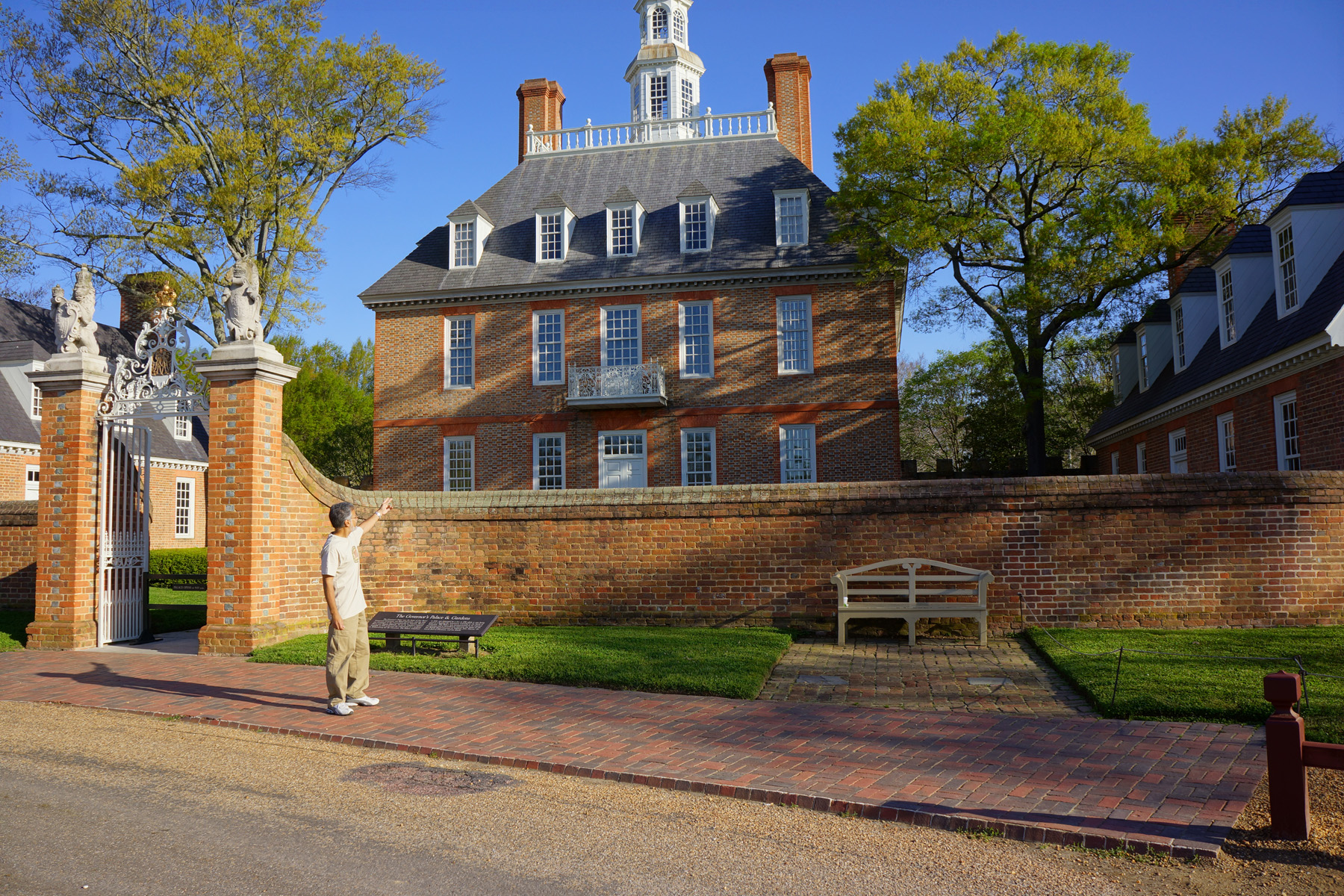
The picture above is of me standing outside of the Governor’s Palace in the nortwest section of the historical Williamsburg area. This was the home of the colony of Virginia’s Royal Governors (before Independence), and then home to famous Americans Patrick Henry and Thomas Jefferson. The picture is from the collection of photos and video clips I’ve gathered for the making of my Kickstarter project intro video. That’s the only thing standing between now and project launch, so I need to edit the visual content together. I’m still penning the text for voice-over narration to the video, so that will likely take me a few days. I hope to have the video complete by the end of the coming weekend so I can get the project off the ground!
I used two cameras for the photography work: my Sony NEX-7 (primarily) and my Sony DSC-HX9v (mainly as a backup). They are both excellent small cameras, and I recently picked up the NEX-7 to replace my Canon 7D. I’ve been a long-time Canon fan, but I got tired of waiting for them to come out with a mirrorless camera offering. For my money, the Sony NEX-7 represented the best bang for the buck. Well, the proof is in the pudding, and the pictures I took of all the Williamsburg sites turned out extraordinarily well.
So far, so good!
Coming to Kickstarter: The Historical Williamsburg Living Narrative
What is the Historical Williamsburg Living Narrative?
Imagine Interactive Fiction crafted around real places and people in history, where not only can a person read about settings and events, but the person can be a part of the unfolding story as an actual character. The intent of the Historical Williamsburg Living Narrative project is to build the geography, culture, and characters from the years surrounding the birth of the United States in Williamsburg, Virginia, using the literary format of Interactive Fiction. This three-phase project will include the development of functional maps, the architecture of the historic buildings, and interaction with significant characters such as Patrick Henry and George Washington. Each phase is a project milestone, completion coming 150 days after start.

The Historical Williamsburg Living Narrative is three things:
- It is a computer game: Individuals will “play” a character out of the historical times around the date of the American Declaration of Independence. They will be able to interact with actual historical figures of the day that lived or visited Williamsburg, Virginia, and they will learn about the events that brought the 13 colonies to sign the Declaration on July 4, 1776. The game environment will be an accurate map environment of Williamsburg as it existed then, and players will be able to roam the streets, enter the buildings, and go anywhere as they encounter people from the past with stories to tell. The game will be in the format of Interactive Fiction, which you can learn more about at the Interactive Fiction Wiki here.
- It is a history lesson come to life: If you are someone interested in the history of how the United States was formed, the Historical Williamsburg Living Narrative will be one of the best ways to learn it. Like a time machine for the imagination, it will transport people back to the days of Thomas Jefferson, Patrick Henry, and Peyton Randolph, where they can learn about the events of the times by talking with these historical figures. Whether you are a history buff, history teacher, or just a fan of Interactive Fiction and period pieces, this game will have something for you.
- It is a Kickstarter project: If you’re not familiar with Kickstarter.com, then you should check it out here. Kickstarter is a wonderful way of funding projects, where individuals may donate funds (in small amounts or large, and anything in between) to get a project off the ground. The Historical Williamsburg Living Narrative is a Kickstarter project, and it will be launched officially sometime in April. More details on participation and rewards will be coming, so you can check back here–or better yet, subscribe to this blog for updates on the project.
This is an exciting project to launch, and we hope to have your participation and support! And be sure to pass the word to anyone that you think may be interested in bringing the history of Williamsburg, Virginia, to life!
 Historical Williamsburg Living Narrative