Interactive Fiction in Education
There is much conversation around the use of computer games in education, but the development of custom game content is often trivial “drill and practice” applications, or the implementation of off-the-shelf games don’t align well–if at all–with curriculum learning objectives. Interactive Fiction (the genre of the Historical Williamsburg Living Narrative) may be ideal for the teaching and learning environment. This article in the Learning Through Play & Technology blog addresses the potential of using custom-developed IF as a purposeful component of curriculum.
The High Road and the Low Road
It’s been a while since the last update, but we’ve been making progress on the the interface and parser coding for the “custom” front end. Additionally, we’ve come to the conclusion that a two-pronged approach is what we will be taking for the two main version releases.
Version 1: This is the first piece that will come out, which is purely a navigation-exploration framework for colonial Williamsburg during the setting we’ve selected. This version will be developed in Inform 7, and it will be available to anyone free of charge. All that will be needed is the proper interpreter to run the program file.
Version 2: This is the full game experience with the story placed on top of the location and time setting. Here is where we go off the beaten path with our custom IF interface, and we’ll be using a development environment called LiveCode by RunRev for the development. LiveCode was chosen specifically for its ability to handle text.
Currently we are developing the map within the Inform 7 environment, and we are also working on the custom LiveCode parser. While progress has been fairly slow, it has been significant, and the level of detail of the colonial Williamsburg environment should be quite satisfying when played.
As always, we appreciate the support and encouragement we’ve been receiving. Stay tuned!
Location, Location, Location!
The map is the thing.
While the colonial Williamsburg environment will be accurately portrayed, some locations will get a more thorough treatment than others. As construction of the game environment moves forward, these are the historic sites that will receive focused attention:
- The Governor’s Palace
- The Randolph House
- The Wythe House and Gardens
- The Courthouse
- The Magazine and Guardhouse
- The Capitol
- King’s Tavern
Additionally, there will be game activity on the Duke of Gloucester Street, and one other (very large) location that, for now, will remain unnamed–and quite essential to the core storyline.
A Bit of Storyline
On April 21st, 1775, the royal governor of the colony of Williamsburg seized the stored gun powder from the community magazine, which quite angered the colonists and gave rise to a rather angry mob. Some might consider this a tactical error, as the colonists still were split over this issue of British rule versus independence; a heavy-handed action such as this only served to strengthen the hand of independence-minded colonists such as Patrick Henry.
As angry as they were, the colonists were very committed to maintaining a dialog with the governor, convinced that men of reason could come to understanding, and ultimately to agreement on the wisest course of action. And on both sides of the issue, violence was an action that was hoped to be avoided.
But what if, as a result of the gun powder incident, actual violence did occur? Suppose the governor had been assassinated in response by the colonists in favor of independence? That might, in fact, shift the balance of public opinion strongly in favor of the British, in an expression of sympathy as well as an expression of disgust at the “savagery” displayed. History might have turned out much differently.
This is an alternate timeline that will be explored in the game. And it will be the player’s role to prevent the murder from taking place, thereby allowing history to unfold as originally did.
Interface versus Intimidation: IF for Non-Readers
For those (relatively few) of us familiar with Interactive Fiction, the simple presentation of text on screen with a single prompt awaiting text input is a welcoming and comfortable thing. Unfortunately, many of today’s game players are “intimidated” by a text-heavy computer screen, and the idea that they must issue a text-based command (rather than move a joystick, press a button, or shake a controller) is almost an insurmountable obstacle to stepping into game play. This situation is problematic when considering how to engage more (and younger) players in the IF genre.
While it is possible to add graphic elements to the IF structure (indeed, this has been done before), too much change in the IF interface results in a transformation away from IF and toward graphic adventure gaming. However, with the Historical Williamsburg Living Narrative, I am very interested in broadening the potential audience. I think that a few additions to the basic IF interface can increase appeal while remaining true to the IF experience. Consider the following possible interface for the project.
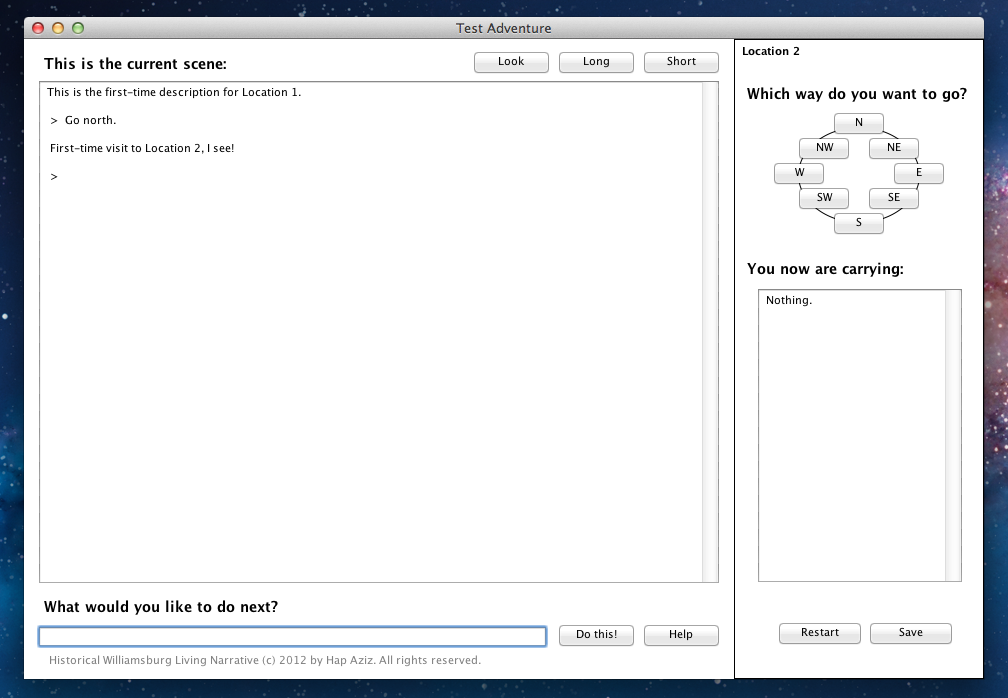
The reasoning behind this interface is to keep everything text-based, provide a few buttons so that IF neophytes can “jump in” by clicking rather than thinking about what to type, and to organize the screen into a few areas: description/command and navigation/inventory. This is something that I’m able to develop using a tool other than Inform 7, and that actually turns out to be a positive thing for me: rolling my own code allows me build specific functionality into the game, and I will have especially good “control” over the NPC interactions throughout the game–a fairly significant consideration.
At this point I’m looking for thoughts and feedback, both on the idea of going a bit non traditional with the interface as well as critiques of the interface itself. This design in only a prototype, but I’d like to know if anyone thinks it is worth developing further. Drop me a note!
The Rockefeller Library: A Treasure Trove of Information
Today the family and I began our foot-tour of the Colonial Williamsburg area, starting with the Governor’s Palace and grounds. The guided tour (which we’ve been on during several visits over the years) provided a good amount of information regarding the use of the rooms, the tone set by the foyer (a “display of British power” was an important characteristic), and the reasons why the various rooms were decorated as they were. After the tour I had the opportunity to chat with our guide, and I asked him for the best sources of floor plans to the historic buildings. He clued me into the Rockefeller Library.
Later in the day, about mid-afternoon, we were rained out of our Williamsburg walkabout (being stuck in the Courthouse during a storm–but after we participated in an several trial role-play scenarios). That turned out to be a blessing, as I was able to spend some time researching the archives of the Rockefeller Library, and I came upon the Architectural Reports. These reports, apparently dating from the 1930s to the present (I haven’t seen them all, but the earliest one I’ve come across was published in 1931), divide Colonial Williamsburg into geographical blocks and provide amazing amounts of detail on the buildings, grounds, and landscaping as they were in the 18th century. This includes the color schemes, furniture, fabrics, dishware, and so on thought to have been in use by the residents.
This material is just what I wanted to find, and it will provide the foundation for the game navigation. My choice now is to decide how much to include in the first revision of the game!
Documenting Williamsburg and a Special Thanks
Tomorrow my family and I will arrive in Williamsburg, where we will spend the weekend and depart on Monday. The goal will be to gather research materials from the Colonial Williamsburg Foundation and perform a physical survey of the colonial city, documenting with photographs and audio notes for later transcription. Technically, while this is work, the environment will cover our days with a great measure of enjoyment.
I’d like to take this opportunity to thank one of the project backers, who also happens to be a personal friend that lives near my home (in Central Florida). The family and I left on this journey last Thursday. We drove up to the suburban Maryland area to visit my mother and sisters (who have their own families and homes between Washington, DC, and Baltimore). In my haste to get on the road, I actually forgot the camera I most wanted to use for the Williamsburg photography. (I also forgot our Williamsburg passes, but since we are annual members, I wasn’t worried about getting in.)
My wife called Marcy M., our backer/neighbor and asked if she would be able to go to our home, pick up the camera and passes, then ship everything to me in Maryland. Marcy came through, and now I’m happy to have the camera I most wanted to use for the photography!
Time for On-Site Research!
One of the exciting things about the Historical Williamsburg project is that Williamsburg is not only a real place, the historical part is to a large extent restored to the condition it was in back in the late 1700s. Research there can be very entertaining as well as informative. Indeed, the city is a living museum, but ever since my father started taking our family there 40 years ago on summer vacations, I’ve seen it as a fun rather than “educational” place to go. But I picked up a lot about American history despite that fact.
From July 13th-16th, I will be there (along with my family) taking photographs and measurements in order to build the map representation of the historical portions of the city within the game. I will be getting the layouts for the major structures such as the House of Burgesses and the Governor’s Palace, along with the interior information for several other buildings (the Courhouse, the Magazine, some of the taverns, homes of prominent residents, etc.). Hopefully the weather will be favorable! There is a lot of work to do on the game itself, but one of my goals of getting the photography work accomplished (in addition to proving me with reference materials for the in-game descriptions) is so that I’ll be able to put together the project’s coffee table photo book that will be one of the rewards for some of the folks that were Kickstarter backers for the project.
During the fundraising phase, I was asked whether or not I would be publishing the photo book for individual purchase, and honestly, I had not considered that. But it does seem like a good idea, so I think that’s a project element worth adding. I’d like to get the materials together, the layout of the book completed, and all the publishing details worked out by the end of the summer. With all the quality self-publishing options out there, I should be able to have the book available for sale, and we’ll see where that goes!
IFComp 2012: The 18th Annual Interactive Fiction Competition is Now Open
 While the Historical Williamsburg Living Narrative won’t be ready by the September 29, 2012, deadline, this competition is very exciting nonetheless! The readers of the Usenet newsgroup rec.arts.int-fiction have put on this IF competition for the last 17 years, and some truly excellent games have gotten well-deserved attention as a result.
We definitely recommend following the competition and checking out the past winners. And you may even want to try your hand at the genre with your own entry. (If you do, be sure to let us know!)
Check out the contest website by clicking here. By the way, you can even help out by donating prizes. Obviously, we judge that to be for a very good cause.
Kickstarter Funding Success!
Thanks to all 85 backers of the Historical Williamsburg Living Narrative, we reached 129% of our $1500 goal, putting us at a final total of $1937. We are quite appreciative of everyone’s most sincere support in the form of hard-earned cash.
Now comes the job of building the game! The first phase of development will be focused on the Williamsburg physical environment, building the map that the game navigation will be based on. That will involve quite a bit of research (already underway), and in a few weeks time, we will be traveling to Williamsburg to obtain photographs, make geographic measurements, and gather materials from the Colonial Williamsburg Foundation. we will keep you posted every step of the way.
In the meantime, we will take a little time to bask in the warmth of this initial success in the project’s lifecycle. We are certainly off to a very good start.
 Historical Williamsburg Living Narrative