Archive
Work Resumed and the End Is in Sight!
An Interactive Narrative for the 250th Anniversary of American Independence
Posted by Hap Aziz, Ed.D. · Development Update
On July 4, 2026, the United States will mark 250 years since the signing of the Declaration of Independence. It is a milestone that invites Americans to look back at the extraordinary spring of 1775 — the months when revolution moved from rhetoric to reality. We are building something for that moment: a text-based interactive narrative called Historical Williamsburg Living Narrative, and after a period away from the project, development has resumed in earnest.
The game is not a quiz. It is not a drill. It is an invitation to step into colonial Williamsburg at one of the most charged moments in American history and see what you can learn by being there.
You are Nathaniel Blake — a wealthy Richmond merchant visiting the Virginia capital on the evening of April 19, 1775. You have appointments with George Wythe and Peyton Randolph. Your ship, the brigantine Perseverance, is in port at Yorktown. And you have just found a sealed letter on the forecourt of the Governor’s Palace.
The Night That Changed Virginia
The date matters enormously. Patrick Henry delivered his famous speech at St. John’s Church in Richmond on March 23, 1775 — just weeks before Blake arrives. The colonies are tense. Militias are drilling. And in Williamsburg, something is about to happen.
On the night of April 20-21, 1775, Lord Dunmore — Virginia’s royal governor — secretly ordered twenty Royal Marines from the armed schooner HMS Magdalen to remove the colony’s gunpowder from the Public Magazine. They worked by lantern light, loading fifteen half-barrels onto a wagon and transporting them to the James River before dawn. When Williamsburg woke up, the powder was gone.
The Gunpowder Incident, as historians call it, was one of the catalytic events of the American Revolution in the South. It provoked Patrick Henry to march on Williamsburg with armed militia. It destroyed whatever remained of Dunmore’s relationship with the colonial government. Within two months, the Governor had fled the Palace and taken refuge on a British warship. Virginia would never again have a royal governor.
In Historical Williamsburg Living Narrative, the player arrives the evening before — and has the opportunity to witness all of it.
What the Game Looks Like
314 Locations to Explore
The game world covers the historic area of colonial Williamsburg in substantial detail: the Governor’s Palace and its grounds, the Wythe House, the Randolph House, Anderson’s Tavern, the Public Magazine, the Capitol building, Bruton Parish Church, Chowning’s Tavern, the Raleigh Tavern, the printing office, the courthouse, and dozens of streets, gardens, and outbuildings connecting them.
Every location has a physical description, time-appropriate ambient detail that changes through the evening and into the early morning hours, and exits to the surrounding world. Move times reflect real distances — a walk from the Palace Circle to the Wythe House takes longer than a step from the Foyer to the Parlor.
Characters Who Know Their World
The game features ten non-player characters, each placed within the historical and social fabric of April 1775 Williamsburg. Players can approach and speak with them, and each character has their own knowledge, opinions, and concerns about the political situation:
- John Anderson — proprietor of Anderson’s Tavern, where Blake is staying
- George Wythe — Virginia’s great legal scholar; one of Blake’s appointments, and a win-condition character
- Peyton Randolph — Speaker of the House of Burgesses; the other win-condition character
- Lord Dunmore — the Royal Governor himself, whom Blake meets in the Palace Parlor
- Mr. Hedges — the Palace butler, a study in composed authority
- Tobias Greer — a printer’s apprentice who has opinions about everything
- Reverend Whitfield — the rector of Bruton Parish, navigating divided loyalties
- Margaret Skelton — a loyalist merchant whose situation grows more precarious by the week
- Cato Freeman — a free Black cooper whose perspective on liberty is unlike anyone else’s in town
- Nance — an enslaved woman in the Randolph household, whose situation the game does not shy away from
Each character has topics they’ll discuss, information only they possess, and — crucially — dialogue that changes after the powder theft. The Williamsburg of April 21 feels different from the Williamsburg of April 20, because it is.
The Governor’s Palace Sequence
The sealed letter Blake finds at the start of the game creates one of the narrative’s most carefully designed sequences. Returning it to the Palace requires Blake to knock at the locked front door, wait while the butler consults the Governor, be received in the Parlor, and sit through a brief but charged audience with Lord Dunmore — who is, on this particular evening, a man with a great deal on his mind.
Dunmore is not a villain in the game’s telling. He is charming, intelligent, and genuinely grateful. He deflects certain questions very smoothly. Players who pay attention to what he doesn’t say will find that the conversation takes on a different character once the powder is gone.
‘The colony’s prosperity and the Crown’s interest are not in conflict, Mr. Blake,’ he says at length. ‘Whatever the political gentlemen may argue. Trade requires order. Order requires authority. These are not complicated ideas, though some seem determined to complicate them.’
A Full Day Before the Theft
One of the most important design decisions made during this development phase was shifting Blake’s arrival to April 19 — giving the player an entire day before the powder removal happens. April 20 becomes an investigation: visit Wythe and Randolph, walk through town, talk to characters about the political climate. Players who know their history may recognize the signs. Players who don’t will learn.
The theft itself happens around 3:50 in the morning of April 21. If Blake is awake and near the Magazine, he witnesses it directly. If he’s asleep at the tavern, he wakes to an uneasy feeling he can’t name — and finds out what happened at dawn.
The game then offers a full day on April 21 to respond: to find Wythe or Randolph and tell them what you know, to speak with characters who are now frightened or angry, to absorb the moment before departure on the morning of April 22.
An Educational Tool First
Historical Williamsburg Living Narrative is designed as an educational tool — suitable for classroom use, self-directed learning, and anyone curious about what life in colonial Virginia actually felt like on the eve of revolution.
The game does not oversimplify. Dunmore had genuine reasons for his actions; the colonists had genuine grievances; the enslaved people of Williamsburg had a perspective on ‘liberty’ that did not map neatly onto Patrick Henry’s. The game tries to hold all of that without turning it into a lecture.
Players who complete the experience will leave with a concrete understanding of: the Gunpowder Incident and why it mattered; the social geography of colonial Williamsburg; the range of political opinion in Virginia in April 1775; and the human texture of a moment that is often reduced to famous speeches and battles.
A Note on the Technology
The game runs as a standalone Windows application with a period-appropriate parchment interface. It requires no internet connection and no installation beyond copying the executable. Save and load functionality allows students to resume progress between sessions, and saved games are stored securely in the user’s application data folder.
The game features a natural-language parser that recognizes multi-word commands and noun phrases — ‘examine the sealed letter,’ ‘talk to George Wythe,’ ‘open the east door’ — rather than requiring rigid syntax. It is intended to feel like reading and playing simultaneously, not like filling in a form.
Looking Ahead
Development is targeting a launch window aligned with the 250th anniversary of American independence in the summer of 2026. Remaining work includes: completing NPC dialogue for all characters, building the full victory condition and scoring system, adding the historically accurate presence of the HMS Magdalen sailors at the Palace, and polishing the dozens of locations that still carry placeholder descriptions.
The bones of the experience are in place. The world exists, the characters speak, the powder disappears in the night, and history turns its corner. What remains is filling in the texture that makes a player feel they were really there.
If you have ever stood in front of the Governor’s Palace in Williamsburg and wondered what it was like on the night before everything changed — this is an attempt to show you.
Historical Williamsburg Living Narrative is a work in progress. Updates will be posted here as development continues. The target platform is Windows; the target audience is anyone who has ever wished history class felt more like being there.
Hap Aziz, Ed.D.
March 2026
Setting the Stretch Goal
Even though the Historical Williamsburg Living Narrative has reached its funding goal, there are 16 days left in the funding period, and we want to put that time to good use. To that end, we are setting a stretch goal of an additional $500 in funding (for a total of $2000 altogether). These additional funds would go toward increased research resources and even some money to market the finished product to the target audience (educators, historians, and IF gamers).
Unlike the initial funding goal, the stretch goal does not have to be hit for us to make use of the additional funds. So at this point, every backer contribution helps us move the needle. Please spread the word and help us to continue to raise funds for the project.
Kickstarter Intro Video Complete: Project Launch in Progress
The Kickstarter introduction video for the Historical Williamsburg Living Narrative is complete, and it is now on YouTube. It’s embedded here for your viewing convenience:
We are now in the process of getting the final Kickstart site details completed, which includes setting the actual donation level awards. The project launch is right around the corner, and we hope you will support us by spreading the word and making a funding donation, big or small!
Wanted: Teachers Interested in Interactive Fiction

- Are you a teacher at any grade level with an interest in history?
- Do you have familiarity with the Interactive Fiction format of computer games (or would you like to know more)?
- Would you be willing to participate in a study on the use of Interactive Fiction in curriculum?
- Would you like to learn how you might make use of the Historical Williamsburg Living Narrative project in your class?
If you answered yes to any of these questions, then we need to connect! The Historical Williamsburg Living Narrative is not just about creating a fun Interactive Fiction computer game about some of the exciting events surrounding the birth of the United States. The project is also about providing a tool that can potentially engage more students in a way that promotes thinking and problem-solving skills that can help in all areas of their academic lives.
To connect with the Historical Williamsburg Living Narrative, feel free to post a comment here, or you may email directly at historicalwilliamsburg@gmail.com. We will be happy to answer any questions you might have about the project or about Interactive Fiction in general, and we will work with you so that you and your students can participate interactively with people and events from the early days of this nation.
Status Update: Kickstarter Launch Checklist
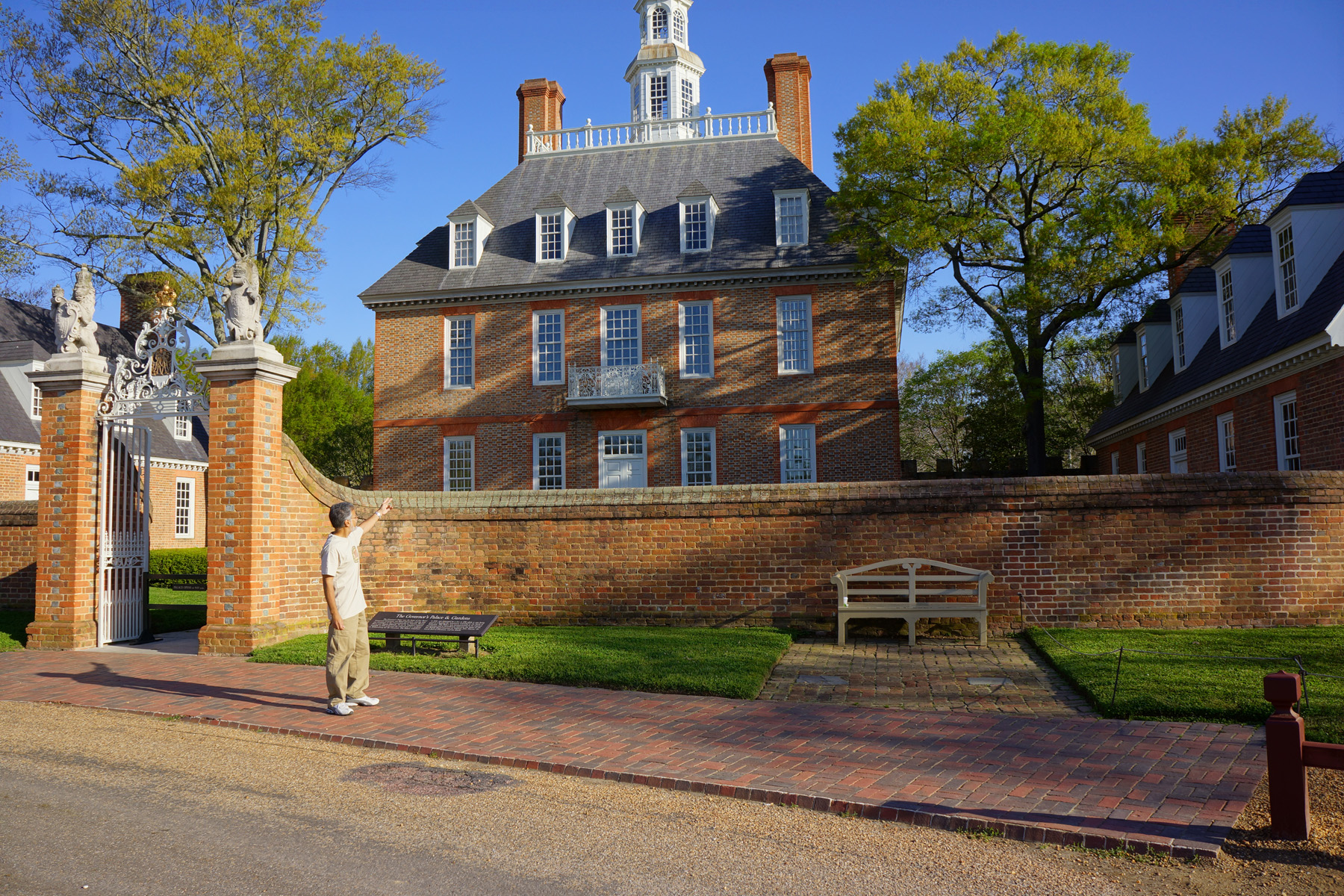
The picture above is of me standing outside of the Governor’s Palace in the nortwest section of the historical Williamsburg area. This was the home of the colony of Virginia’s Royal Governors (before Independence), and then home to famous Americans Patrick Henry and Thomas Jefferson. The picture is from the collection of photos and video clips I’ve gathered for the making of my Kickstarter project intro video. That’s the only thing standing between now and project launch, so I need to edit the visual content together. I’m still penning the text for voice-over narration to the video, so that will likely take me a few days. I hope to have the video complete by the end of the coming weekend so I can get the project off the ground!
I used two cameras for the photography work: my Sony NEX-7 (primarily) and my Sony DSC-HX9v (mainly as a backup). They are both excellent small cameras, and I recently picked up the NEX-7 to replace my Canon 7D. I’ve been a long-time Canon fan, but I got tired of waiting for them to come out with a mirrorless camera offering. For my money, the Sony NEX-7 represented the best bang for the buck. Well, the proof is in the pudding, and the pictures I took of all the Williamsburg sites turned out extraordinarily well.
So far, so good!
Coming to Kickstarter: The Historical Williamsburg Living Narrative
What is the Historical Williamsburg Living Narrative?
Imagine Interactive Fiction crafted around real places and people in history, where not only can a person read about settings and events, but the person can be a part of the unfolding story as an actual character. The intent of the Historical Williamsburg Living Narrative project is to build the geography, culture, and characters from the years surrounding the birth of the United States in Williamsburg, Virginia, using the literary format of Interactive Fiction. This three-phase project will include the development of functional maps, the architecture of the historic buildings, and interaction with significant characters such as Patrick Henry and George Washington. Each phase is a project milestone, completion coming 150 days after start.

The Historical Williamsburg Living Narrative is three things:
- It is a computer game: Individuals will “play” a character out of the historical times around the date of the American Declaration of Independence. They will be able to interact with actual historical figures of the day that lived or visited Williamsburg, Virginia, and they will learn about the events that brought the 13 colonies to sign the Declaration on July 4, 1776. The game environment will be an accurate map environment of Williamsburg as it existed then, and players will be able to roam the streets, enter the buildings, and go anywhere as they encounter people from the past with stories to tell. The game will be in the format of Interactive Fiction, which you can learn more about at the Interactive Fiction Wiki here.
- It is a history lesson come to life: If you are someone interested in the history of how the United States was formed, the Historical Williamsburg Living Narrative will be one of the best ways to learn it. Like a time machine for the imagination, it will transport people back to the days of Thomas Jefferson, Patrick Henry, and Peyton Randolph, where they can learn about the events of the times by talking with these historical figures. Whether you are a history buff, history teacher, or just a fan of Interactive Fiction and period pieces, this game will have something for you.
- It is a Kickstarter project: If you’re not familiar with Kickstarter.com, then you should check it out here. Kickstarter is a wonderful way of funding projects, where individuals may donate funds (in small amounts or large, and anything in between) to get a project off the ground. The Historical Williamsburg Living Narrative is a Kickstarter project, and it will be launched officially sometime in April. More details on participation and rewards will be coming, so you can check back here–or better yet, subscribe to this blog for updates on the project.
This is an exciting project to launch, and we hope to have your participation and support! And be sure to pass the word to anyone that you think may be interested in bringing the history of Williamsburg, Virginia, to life!
 Historical Williamsburg Living Narrative